HailBytes SAT for MSSPs: Running Multi-Client Phishing Simulations at Scale
January 29, 2026 • 10 min read

Watch: HailBytes SAT on AWS - Architecture and Deployment Walkthrough (6 min)
Updated 3 September 2026. The 8-vCore floor this post was revised for has been retired. As of 27 August 2026 the 2 and 4 vCore plans are purchasable again, which reverses the conclusion the August revision reached: a dedicated instance per client is economic again well below the sizes named here, because that instance is sized to the client rather than to 8 vCPU. Against a ~$18/user tier the dedicated shape breaks even around 343 seats at list or 273 on a commitment.
Managed security service providers face a specific challenge with phishing simulations: they need to run campaigns across dozens of clients with complete data isolation, different template sets, different schedules, and different reporting requirements, without the cost structure of a per-seat SaaS platform multiplied across every client. Per-seat awareness platforms are estimated at roughly $18–$50 per user per year depending on vendor and tier (see our comparison matrix for the per-vendor bands; none of these vendors publish list pricing). Across a client base totalling 10,000 employees that is a six-figure licensing line before you have delivered anything. Most MSSPs absorb that cost and deliver thin margins, or they skip phishing simulations entirely.
HailBytes SAT changes the economics. The marketplace meter is $0.24/vCPU-hour: $1,400/month on the 8-vCPU size, $16,800/year at list, and a single instance handles unlimited users and campaigns. Your cost scales with instance size, not with employee count. It does not have to scale with client count either: one instance carries multiple client organizations when the MSSP operates the platform, with row-level data isolation, per-client sending identities, and per-client hostnames. Clients that require their own branding, their own identity provider, or self-service administration need a dedicated instance. Consolidate the ones that don’t, and you keep full control over the infrastructure, the data, and the reporting.
The other thing that has changed since this article was first written: HailBytes now ships official Terraform modules for the three deployment topologies MSSPs actually use in production. You don’t build the IaC; you adopt it. The modules live at github.com/HailBytes/hailbytes-terraform-modules under MPL-2.0.

MSSP Multi-Client Architecture - Isolated Environments, Shared Infrastructure
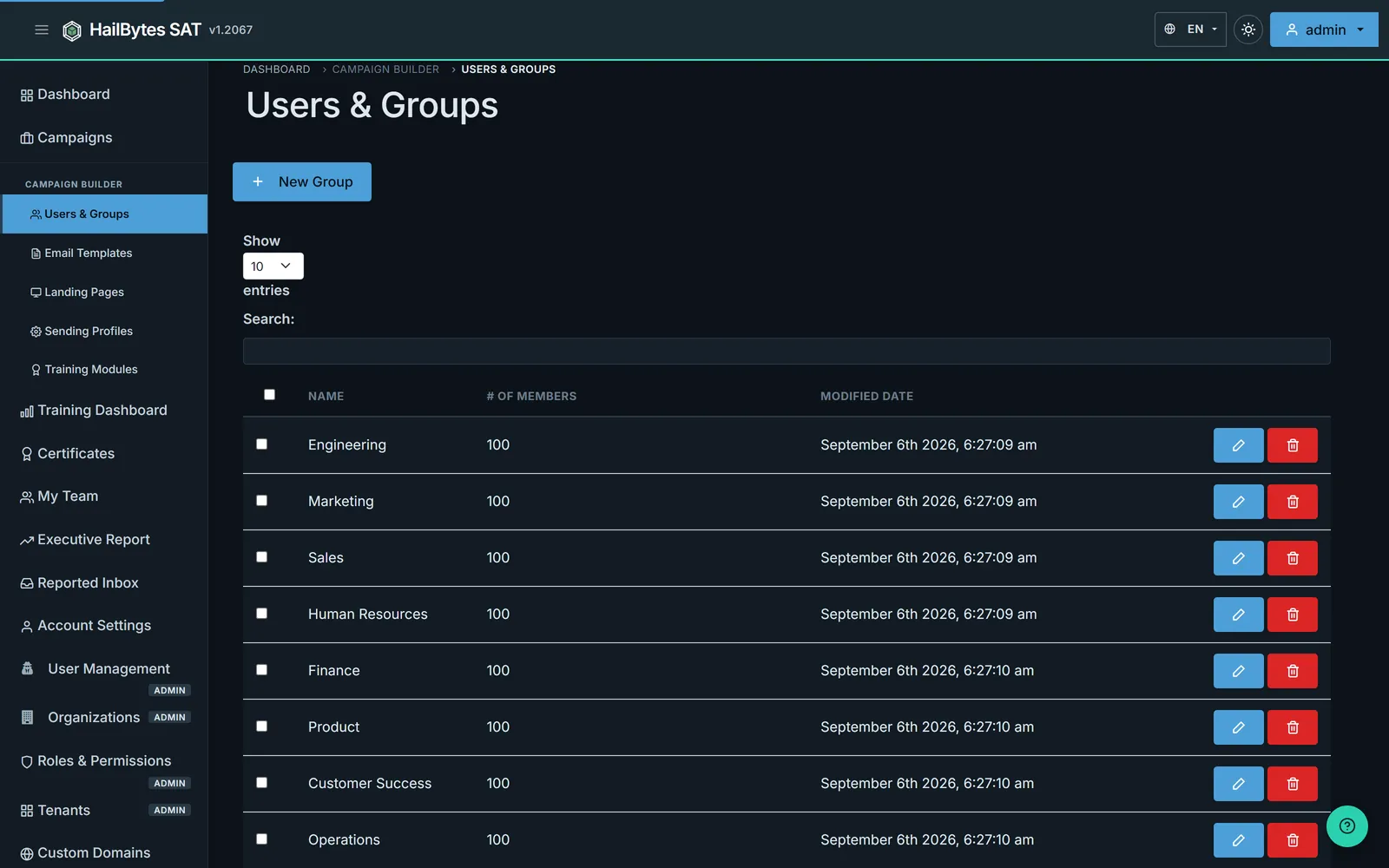
Per-client groups in HailBytes SAT - segment each client's departments inside their dedicated instance.
Pick a deployment shape: three topologies, one per-vCPU meter
The same marketplace image deploys into one of three reference topologies. Same product, same per-vCPU meter rate across all three: the delta is infrastructure shape, not licensing. Pick the shape that matches the client’s SLA, not their seat count:
- Single instance per client: ~$1,680/mo all-in at the 8-vCPU floor ($1,400 meter + ~$280 infrastructure). The classic white-label model. Each client gets a clean tenant boundary in your AWS/Azure account or theirs. Tears down cleanly on churn. With the 2 and 4 vCore plans restored this shape pays for itself on mid-size clients again, because the instance is sized to the client rather than to 8 vCPU. Terraform:
sat-aws-single/sat-azure-single. - HA hot-hot per client: two 8-vCPU nodes, 16 metered vCPU, ~$3,360/mo all-in ($2,800 meter + ~$560 infrastructure). For clients with formal uptime SLAs in their MSA (regulated industries, healthcare, financial services). Adds an ALB, Multi-AZ RDS, and a shared Redis session store. Pre/post-patch SSM verifiers ship with the Terraform module so your rolling-update cadence is documented and auditable. Terraform:
sat-aws-ha/sat-azure-ha. - Auto-scaling (one tenant, many client organizations): from a two-node baseline of identical 8-vCPU nodes, so 16 metered vCores ($2,800/mo meter + ~$560 infrastructure before read replicas), and the meter scales linearly from there at $1,400/mo per further node. For regional MSSPs serving many client organizations from a single shared tenant, which is where the per-client cost gets genuinely competitive. Read replicas, rolling instance refresh with auto-rollback on 5xx, ElastiCache shared session store. Common shape for MSSPs running 100+ campaigns/month or seasonal load. Terraform:
sat-aws-autoscale/sat-azure-autoscale. How many organizations one instance carries is a throughput question we do not publish a number for. Size it against your own campaign volume.
Cross-cloud parity is intentional: an AWS HA deployment and an Azure HA deployment land within ~6% of each other at procurement-grade sizing. Pick whichever cloud the client’s finance team already has committed spend on. The COST_SHAPES.md table in the Terraform repo has the full side-by-side, and the marketplace topology page has customer-shape examples for each.
Architecture: One Instance Per Client (Single + HA shapes)
For the per-client tenant model, the cleanest multi-client architecture uses dedicated HailBytes SAT instances per client. Each client gets their own EC2 / Azure VM from the marketplace image, running in your MSSP’s cloud account (or the client’s, depending on your service model). Data isolation is physical, no shared databases, no shared credentials, no risk of campaign data leaking between clients.
That physical boundary is the strongest isolation story you can tell an auditor, and it is what you want when the client’s MSA demands it. It is also the most expensive shape per client. The alternative is the shared-tenant topology, where one instance hosts many client organizations with row-level isolation, per-client sending identities, per-client hostnames, and an org-scoped compliance export you send each client.
Be precise about what the shared shape does and does not give you, because it decides which clients can go on it:
- Isolated per organization: users, groups, campaigns, training, results.
- Per client: the sending identity and a custom hostname.
- Instance-wide, and therefore yours: branding, the single-sign-on configuration, the SCIM endpoint, the audit log. There is one branding record and one configuration per identity provider per instance, so a shared instance wears one brand and answers to one directory, both of them the MSSP’s.
- Not available: client self-service administration. The organization and user endpoints require system-level permission, so a client admin cannot invite their own users into their own organization.
So: choose the dedicated instance when the contract requires a physical boundary, when the client wants their own brand or their own identity provider, or when they want to administer themselves. Choose the shared tenant for the clients who are happy to receive reports from you, which, in most MSSP books, is most of them.
This approach has operational benefits beyond isolation. When a client churns, you terraform destroy and all associated data is gone. When a client requests a penetration test that includes phishing, you spin up a fresh instance with the same module, run the engagement, export the report, and tear it down. No cleanup, no data retention concerns, no shared infrastructure to audit.
New client onboarding is a single terraform apply. The module handles VPC selection, security groups, encrypted storage, IMDSv2, KMS-backed Postgres, and (on the HA shape) the ALB, Multi-AZ RDS, ElastiCache, pre-patch S3 backup bucket with Object Lock, and the SSM pre/post-patch verifier scripts. Tag instances by client name, engagement type, and status; aws ssm or Azure Run Command from there.
Template Management Across Clients
Phishing templates are the core intellectual property of an MSSP’s simulation practice. Build a master template library organized by difficulty level (easy, moderate, hard, spear-phish), scenario type (credential harvest, malware download, BEC), and industry vertical (healthcare, finance, technology, government). Store templates as HTML files in a Git repository, version-controlled and reviewed by your red team.
When onboarding a new client, deploy the appropriate template set based on their industry and maturity level. A healthcare client gets templates themed around EHR system updates, HIPAA training notifications, and insurance provider communications. A financial services client gets wire transfer confirmations, audit request notices, and regulatory compliance alerts. Customization is the difference between a generic simulation and one that tests whether employees recognize the threats they actually face.
HailBytes SAT’s template system supports merge fields for per-client personalization. Build templates with variables for company name, internal system names, and sender identity. A single template becomes instantly reusable across clients by swapping the merge field values. Your red team builds templates once; your delivery team deploys them everywhere.
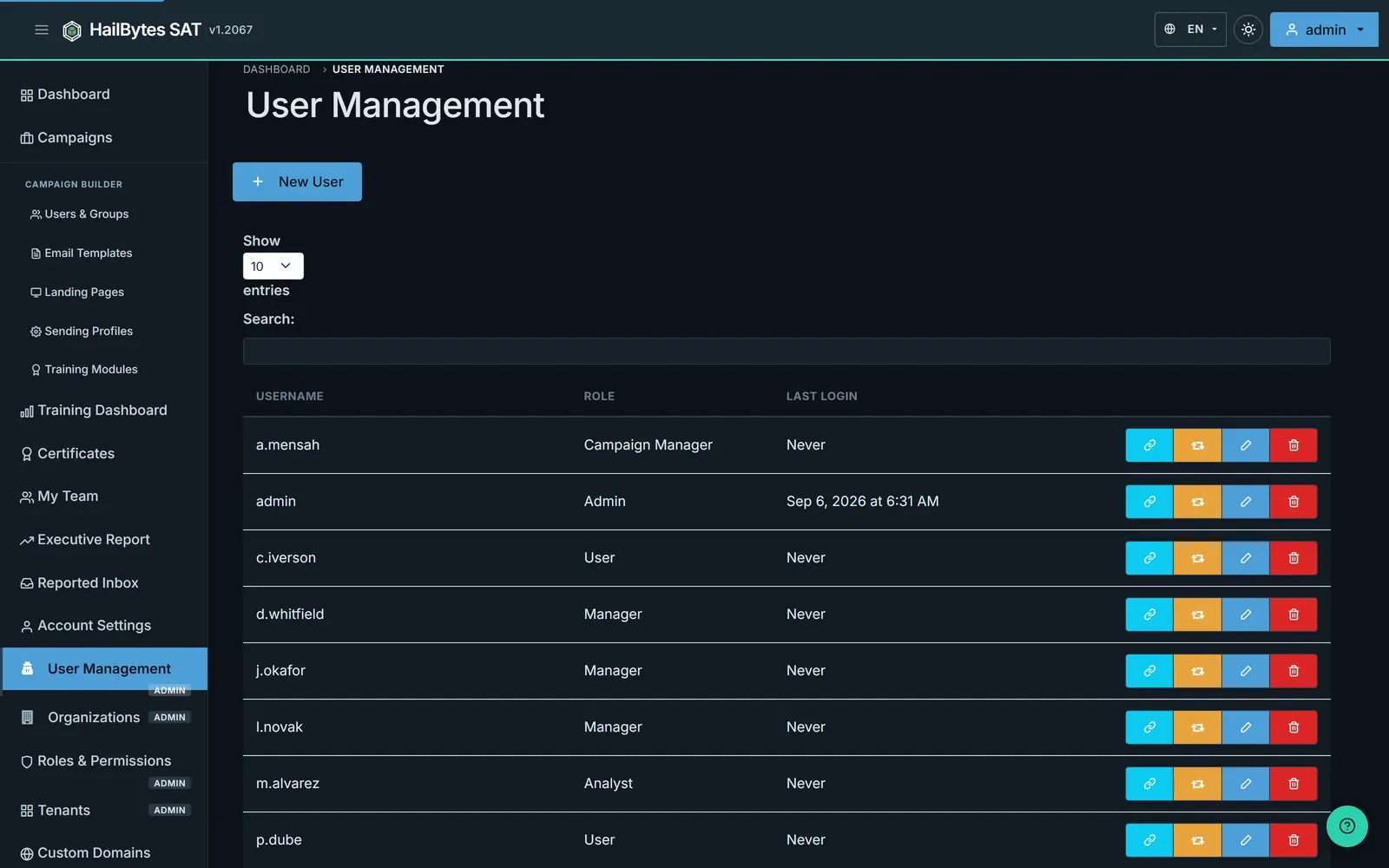
Role-based User Management per client instance - give the client's security team read-only access while your analysts keep admin rights.
Reporting That Your Clients Will Actually Use
MSSPs live and die by their reports. HailBytes SAT exports campaign data as CSV, which gives you raw material but not a client-ready deliverable. The recommended approach: build a reporting template in your preferred tool (Google Slides, PowerPoint, or a BI dashboard) that pulls from HailBytes SAT’s CSV exports and auto-populates the metrics.
A strong MSSP phishing report includes five sections: executive summary (one paragraph, one key number), campaign details (template used, timing, target count), results breakdown (click rate, credential submission rate, time-to-click distribution), department comparison (which departments are most vulnerable), and recommendations (specific next steps with urgency ratings). The report should take 30 minutes or less to produce per client per month - if it takes longer, your template needs work.
For clients who want real-time visibility, HailBytes SAT’s web dashboard can be accessed directly. Set up a reverse proxy with HTTP basic auth or VPN access so the client’s security team can watch campaign results in real time without needing SSH access to the underlying instance. Do this on a dedicated instance only. On a shared instance, giving a client login is the one thing we would not do today: the audit log is not partitioned by organization, so client-facing logins belong behind their own deployment rather than behind a proxy on your shared one.
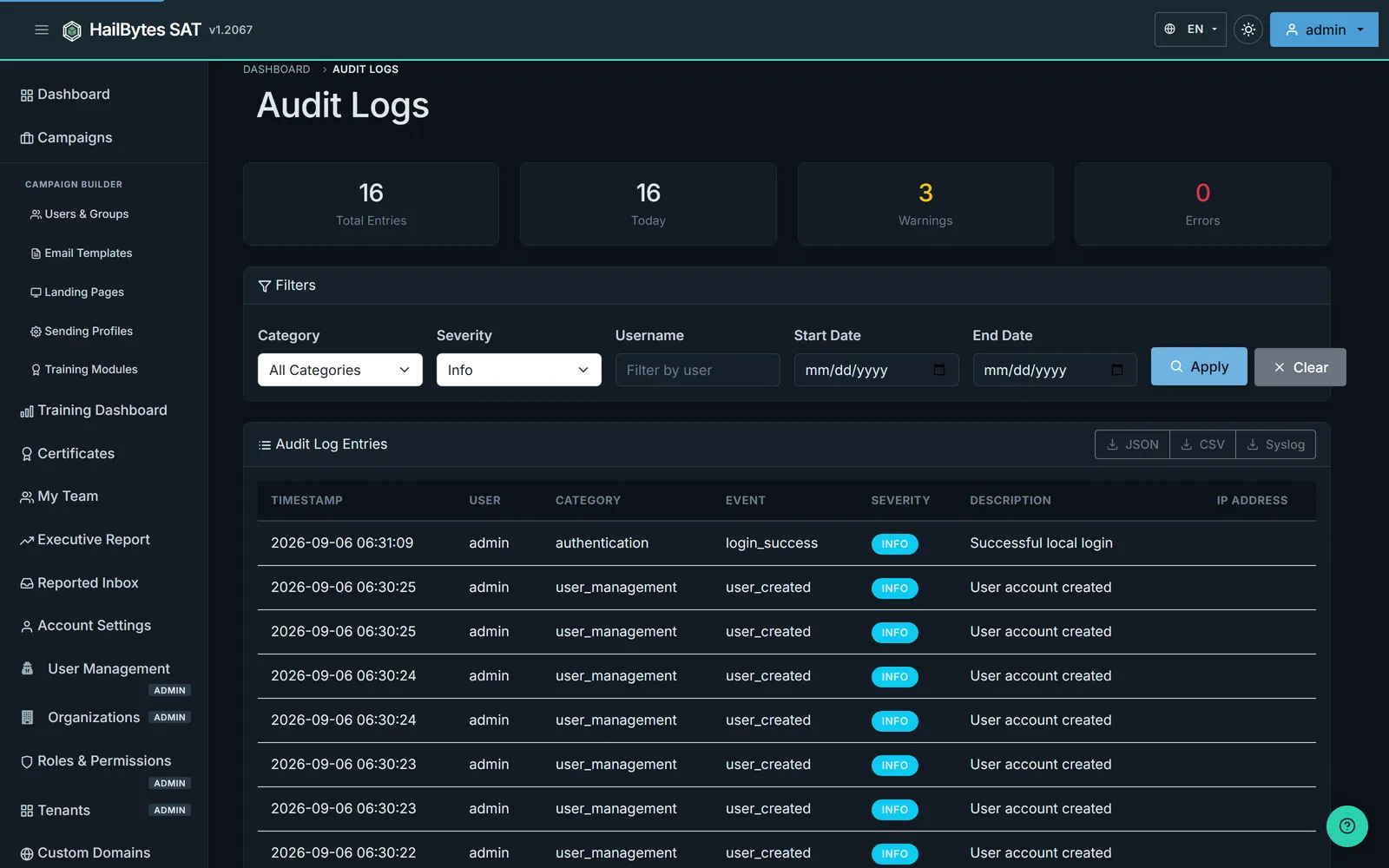
Per-client Audit Logs - JSON and CSV exports, plus REST API and webhooks, plug straight into your MSP SIEM or client-facing reporting pipeline.
Pricing Your Phishing Simulation Service
The standard MSSP pricing model for phishing simulations is per-employee per-year, matching how the enterprise SaaS vendors price. The difference is that your cost is fixed per instance rather than per seat, but at the 8-vCPU floor the instance is no longer cheap, so where you land depends on whether the client sits on their own instance or shares one.
All crossovers here are all-in, including the cloud infrastructure you pay for yourself, against the competitor’s per-seat fee alone. Against KnowBe4’s estimated ~$18/user entry tier, a dedicated instance sized to the client needs about 343 seats to break even at list, or about 273 on a one-year commitment. Consolidated as one organization among several on a shared instance, the allocated platform cost lands at roughly $1,320–$4,080 per client per year all-in ($1,100–$3,400 of software plus infrastructure in the same proportion) which puts the crossover at roughly 75 to 230 seats per client depending on how far the consolidation goes. Note that the per-client figure does not depend on which rung of the ladder you are on; the relationship is linear, so a bigger instance carrying more organizations lands in the same band.
A typical MSSP tiered offering: Basic (quarterly campaigns, standard templates, summary report) at $2–$4 per user/year. Professional (monthly campaigns, industry-specific templates, department-level reporting, repeat offender tracking) at $5–$8 per user/year. Premium (monthly campaigns plus targeted spear-phishing for executives, custom templates, remediation coaching for repeat offenders, compliance-ready evidence packages) at $10–$15 per user/year.
Worked example, with the basis stated so you can check it. At the Professional tier a 1,000-person client generates $5,000–$8,000 of annual revenue. Analyst time is 2–3 hours a month at $90/hour loaded (that is the rate this and the companion article use throughout, so substitute your own if it differs) which is $2,160–$3,240 a year.
- Dedicated instance: platform cost $20,160/year all-in at list ($16,800 software + ~$3,360 infrastructure), or $15,120 on a one-year commitment. Revenue never covers it. That client loses money on a dedicated instance however you run the campaigns.
- Consolidated as one organization on a shared instance: platform cost $1,320–$4,080/year all-in. Contribution runs from about −$2,320 (revenue at $5,000, platform at the top of the band, 3 analyst hours a month) to about +$4,520 (revenue at $8,000, platform at the bottom of the band, 2 hours a month). The spread is wider than the headline suggests, and the analyst-time line is the half you control.
Above ~1,000 seats the unit economics get materially better; below that most MSSPs run the Basic tier, consolidate, or pass the meter through via private offer so the platform line leaves their P&L entirely. The companion article on white-label SAT margin economics has the full P&L by seat band.
Reselling through AWS CPPO or Azure Multiparty Private Offer
The marketplace path most MSSPs miss until late in their evaluation is the channel-partner private-offer flow on both AWS and Azure. It is what lets you mark up the platform, capture the resale margin, and have the customer’s purchase still count toward their EDP or MACC commitment, without the customer having to onboard HailBytes as a new vendor.
- AWS Channel Partner Private Offers (CPPO): HailBytes (as the ISV / seller of record on the AWS Marketplace listing) authorizes you as a channel partner to extend a private offer to your end customer. You set the resale price (HailBytes wholesale + your margin) and the term. Your customer transacts through their own AWS account, the purchase decrements their AWS EDP or PPA commitment, and AWS routes the wholesale share to HailBytes and the resale margin to you. You stay the contracting party for service delivery.
- Azure Multiparty Private Offer (MPO): the Microsoft equivalent, launched on Azure Marketplace in 2024. HailBytes (ISV) + you (CSP / managed-service partner) + the customer transact through a single private offer. Customer purchase decrements their MACC, HailBytes is paid the wholesale share, you keep the resale margin. The Microsoft seller gets co-sell credit on the deal, which keeps them aligned with you on growing the account.
Practically: a 20-client portfolio where each client buys their own single-shape deployment looks like $16,800/yr of metered wholesale per client at list, or $11,760 on a one-year commitment. Add up to 20% resale margin into the CPPO/MPO offer (that margin is taken off the post-discount net the customer actually pays, not off list, so on twenty one-year commitments it is up to $47,040/year) plus your managed-service fee on top, and the entire stack still rolls onto one AWS or Azure invoice per client. Note the private offer covers the marketplace meter only; the customer’s own VM, database and storage are billed separately by the cloud provider. The customer’s procurement team sees one line item; their CFO sees committed-spend drawdown; their CISO sees the audit-ready evidence packet. You see retained margin on the platform plus the managed-service ARR.
To get authorized to resell HailBytes through AWS CPPO or Azure MPO, register through the channel partner program: we issue resale authorization keyed to your AWS account ID or Azure tenant ID and can have your first private offer ready within a business day.
Build Your Phishing Simulation Practice
HailBytes SAT gives MSSPs the infrastructure to offer phishing simulation services at scale - with margins per-seat SaaS platforms can’t match once you consolidate clients onto shared instances. Launch a shared multi-tenant instance, or a dedicated one per client, in minutes.